CPSC hosted Second Pakistan-China Think Tank Dialogue
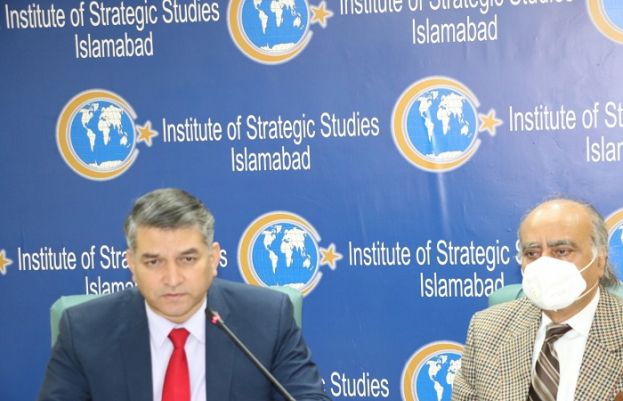
The dialogue focused on the emerging strategic environment, regional dynamics, and Pakistan-China cooperation to advance peace and stability. The dialogue was addressed by Ambassador Aizaz Ahmad Chaudhry, Director-General Institute of Strategic Studies Islamabad and Ms Pan Chunxue, Deputy Chief of Mission, Embassy of China in Islamabad.
The dialogue brought together eminent experts of Pakistan-China relations including Dr Fazal ur Rehman, Director Pakistan Institute of China Studies, Dr Wang Shida, Deputy Director China Institutes of Contemporary International Relations, Mr Amir Rana, Director Pakistan Institute of Peace Studies and Prof Zhang Jiadong, Director Center for South Asian Studies, Fuda University.
Dr Talat Shabbir, in his introductory remarks, thanked the esteemed speakers and highlighted the changing regional dynamics. He underlined that amid change, Pakistan-China relationship remains a constant as both sides continue to maintain close political and strategic communication and coordination to stabilize the regional environment.
Ambassador Aizaz Ahmad Chaudhry, Director-General ISSI, in his welcome remarks, underscored that China is not interested in strategic competition; it rather focuses on economic competition for its peaceful rise. Pakistan-China friendship is an important element for maintaining peace in South Asia. US and India are not in favour of China’s BRI and CPEC and that’s why
the role of think-tank is important in building a positive narrative and these dialogues are significant and Pakistan-China both have to counter that propaganda against CPEC.
Ms. Pang Chunxue, Deputy Chief of Mission, in her remarks, highlighted traditional and non-traditional issues that continue to influence regional dynamics. Referring to COVID-19 pandemic, she underlined that it has changed the international environment in unexpected ways. Meanwhile, as new challenges come up, so do the need for closer cooperation and coordination between regional countries.
Meanwhile, panellists highlighted various aspects of the contemporary strategic environment with a focus on the probable shift in regional politics as the new administration of Joe Biden takes over in the US, the influence of Indo-Pacific strategy of China’s approach to South Asia. Meanwhile, experts debated ways in which Pakistan and China can respond to hegemonic ambitions of Hindutva inspired Indian leadership. The discussion also explored regional coordination to support the going Afghan peace process and India-Pakistan tensions, regarding the situation in Indian-occupied Kashmir.
Ambassador Khalid Mahmood, Chairman ISSI, in his concluding remarks, highlighted that strengthening relations with China is the cornerstone of Pakistan’s foreign policy. Pakistan will continue to closely engage with China to foster regional stability. He also thanked speakers for participating in the dialogue, which is becoming an annual feature of the CPSC.
from latest-news - SUCH TV https://ift.tt/3nLzEkV


Comments
Post a Comment